Icon
Related news and articles
Using
Plugin produces creating:
Plugin dialog window:
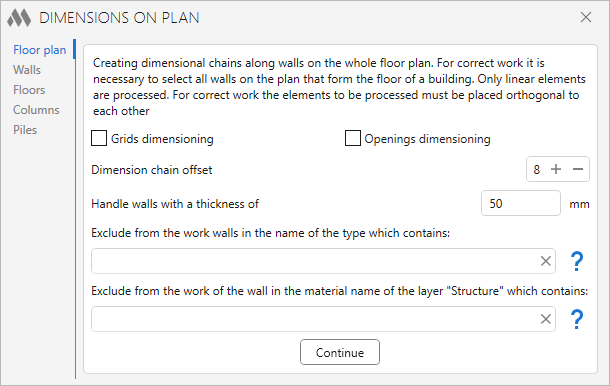
On the left side of the window are tabs corresponding to the different element categories for which dimensions can be created.
The right side contains the settings for the selected tab.
On all tabs, the Type drop-down list allows you to select the dimension type to be used.
Use the Select from current and Select from linked buttons to select elements and grids, allowing you to build a list of elements from the current or a linked document. The number of selected elements is displayed next to each list, and the  button clears the corresponding list.
After configuring the settings and selecting the elements, click the Continue button to create the dimensions.
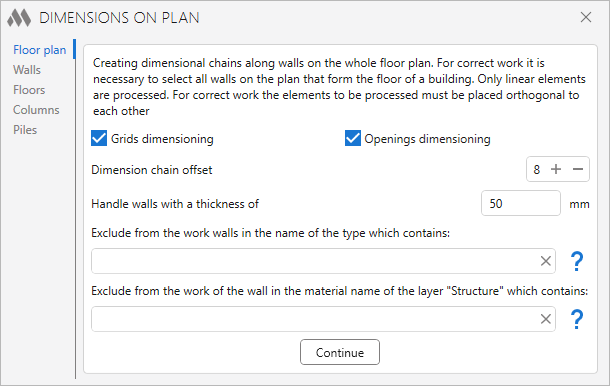
The settings window has the following controls:
Grid dimensioning – if this option is enabled, it will be necessary to select the grids to which the dimension chains will be attached.
Openings dimensioning – if this option is enabled, the dimensions will be created according to the openings of the wall to be processed.
Dimensioning chain offset – specify the offset of the dimension chain from the wall surface.
Handle walls with a thickness of ... mm – specifies a value to filter walls before processing. Allows to exclude finishing when finishing is performed by walls.
For more flexible configuration, it is possible to exclude certain elements:
Exclude from the work walls in the name of the type which contains – excludes from processing the walls that contain in the type name the value written in the string. No case sensitive. You can specify multiple values separated by commas.
Exclude from the work of the wall in the material name of the layer “Structure” which contains – excludes from processing walls that contain in the material name of the layer "Structure" the value written in the string. No case sensitive. You can specify multiple values separated by commas.
With  it is possible to get help for writing values to a string directly in the plugin window.
Only mutually perpendicular elements that do not have arc segments in the geometry are processed.
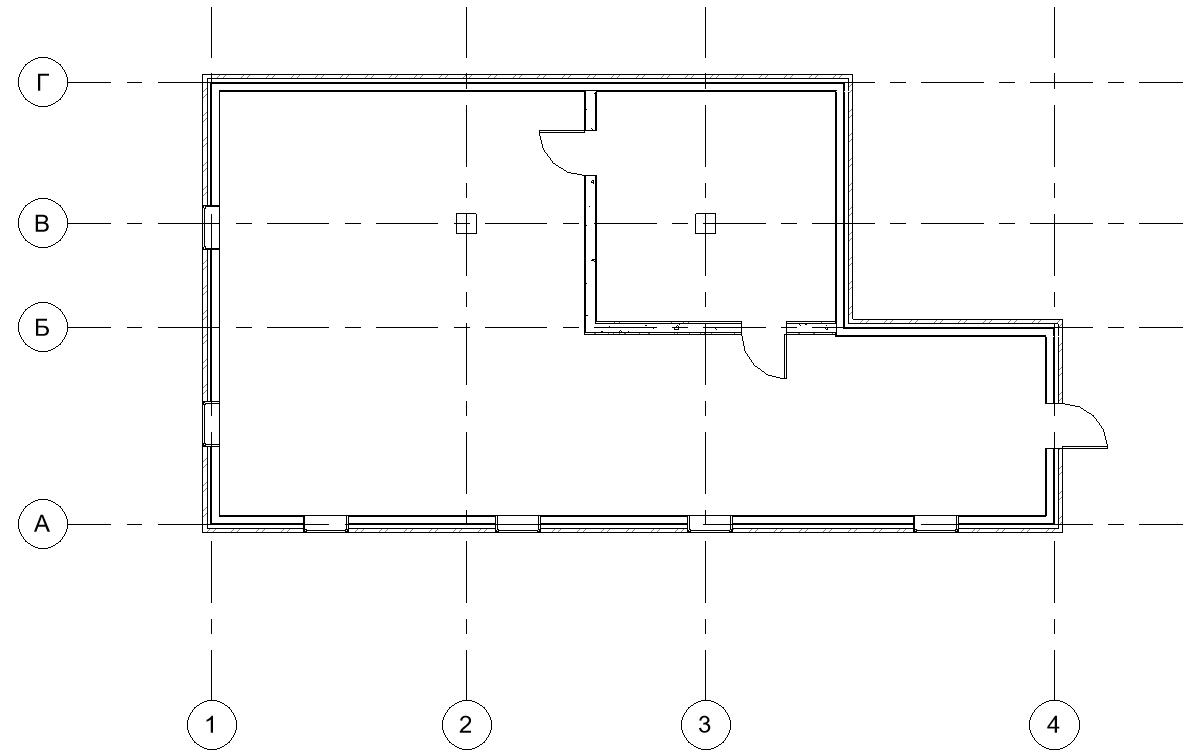
Before dimensioning with the plugin:
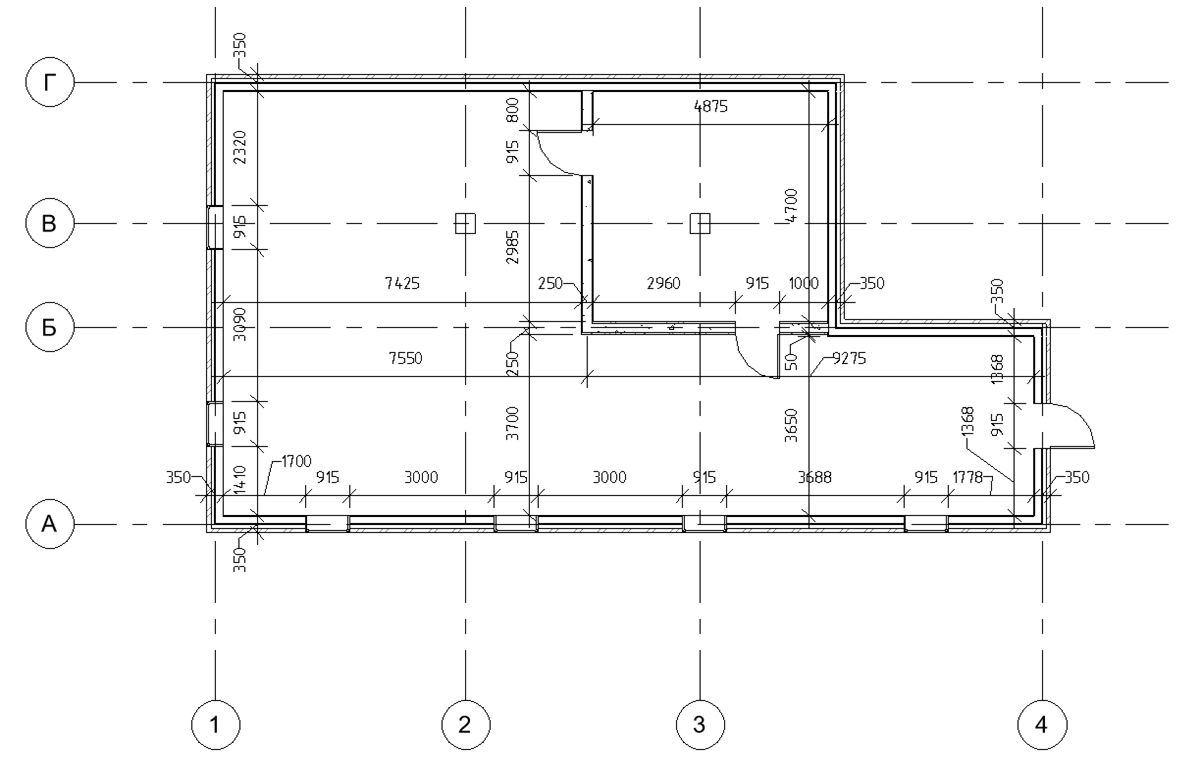
After dimensioning with the plugin:
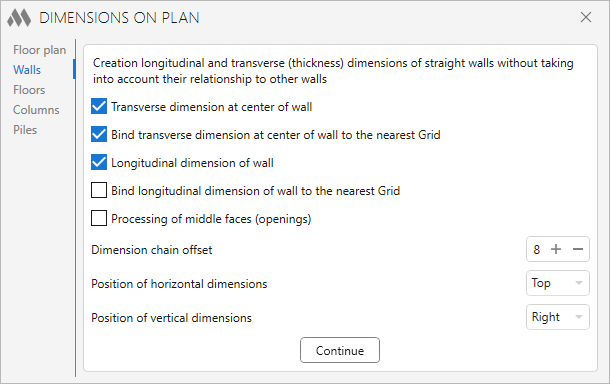
The plugin performs the setting of longitudinal and transverse (thickness) dimensions of straight walls without taking into account their relationship to other walls.
The settings window has the following controls:
Transverse dimension – when this option is enabled, a transverse dimension will be created. Two placement options are available: at center of wall and at end of wall.
Binding the transverse dimension to the nearest grid – when this option is enabled, an additional dimension chain will be created to the nearest grid. If the grid intersects the wall, only dimension chains between the wall and the grid will be created.
If no free end is available, place the dimension at the center – available for the at end of wall option. Allows the dimension to be placed through the wall centerline if it cannot be placed from the wall end.
Longitudinal dimension of wall – if this option is enabled, the longitudinal dimension of the wall will be created.
Bind longitudinal dimension of wall to the nearest Grid – If this option is enabled, an additional dimension chain will be created to the nearest grid. If the grid crosses a wall, only the dimensional chains between the wall and the grid will be drawn.
Processing of middle faces (openings) – if this option is enabled, the dimensions will be created according to the openings of the wall to be processed.
Only non integer dimension values – when this option is enabled, only dimensions containing a fractional part will be created.
Dimension chain offset – defines the indentation of the dimension chain from the edge of the element.
Position of horizontal dimensions – specifies the placement of horizontal dimensions (Bottom, Top).
Position of vertical dimensions – defines the placement of vertical dimensions (Right, Left).
Consider view range – when this option is enabled, elements located below the cut plane of the primary range will not be processed.
If the options for dimensioning to grids are enabled, grids must be selected in the current or linked document.
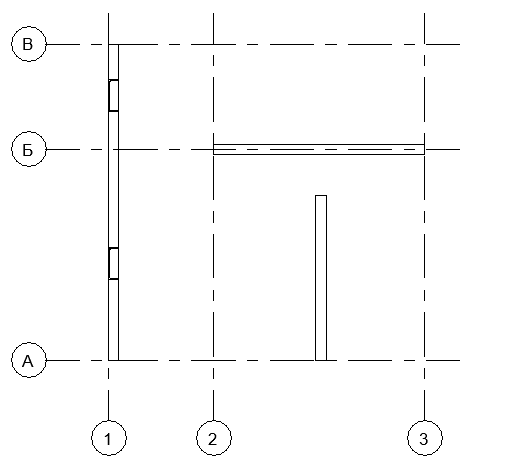
Before to the dimensioning with the plugin:
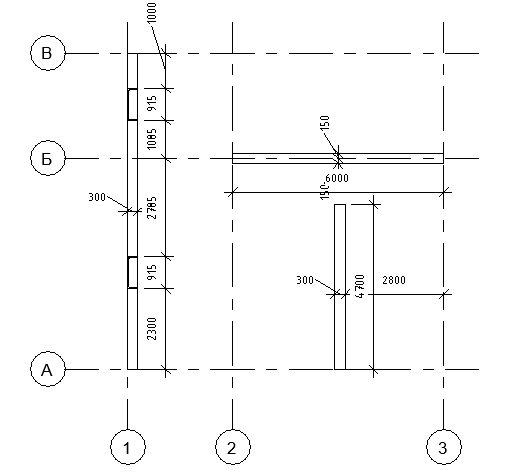
After dimensioning with the plugin:
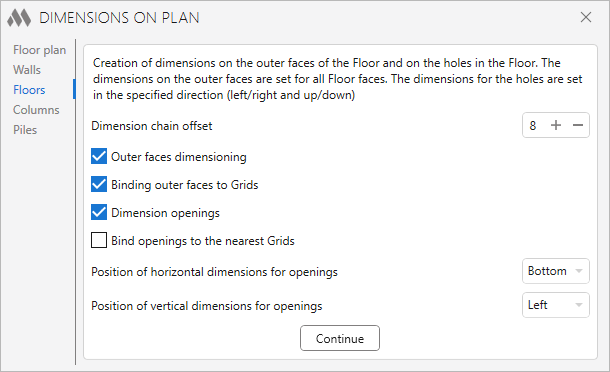
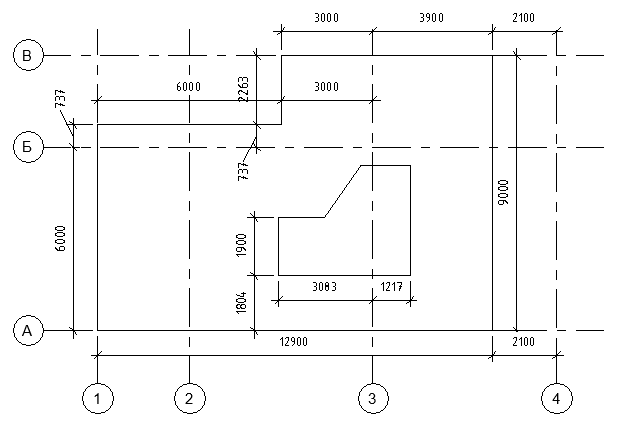
The plugin performs dimensioning on the outer faces of the Floor and on the holes in the Floor.
The settings window has the following controls:
Dimension chain offset – defines the indentation of the dimension chain from the edge of the element.
Outer faces dimensioning – if this option is enabled, dimension on the outer faces of the floor will be created.
Binding outer faces to Grid – If this option is enabled, an additional dimension chain will be created to the nearest grid. If the grid crosses a faces, only the dimensional chains between the face and the grid will be drawn.
Dimension openings – if this option is enabled, it is possible to select the openings in the floor to which the dimensional chains will be attached.
Bind openings to the nearest Grid – If this option is enabled, an additional dimension chain will be created to the nearest grid. If the grid crosses an openings, only the dimensional chains between the openings and the grid will be drawn.
Position of horizontal dimensions for openings – specifies the placement of horizontal dimensions for openings (Bottom, Top).
Position of vertical dimensions for openings – defines the placement of vertical dimensions for openings (Right, Left).
If the options for dimensioning to grids are enabled, grids must be selected in the current or linked document.
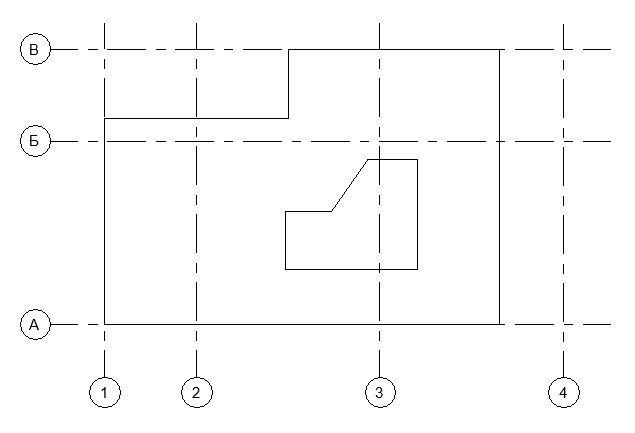
Before to dimensioning by the plugin:
After dimensioning with the plugin:
COLUMNS
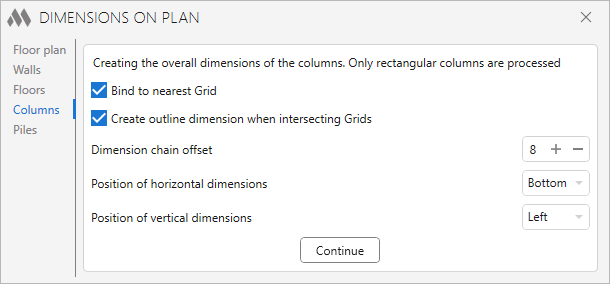
Plugin performs the dimensioning of the columns.
The settings window has the following controls:
Bind to nearest Grid on one side/on both sides when intersecting – when this option is enabled, columns will be dimensioned to grids on one side or on both sides, depending on the selected mode. In this case, grids must be selected in the current or linked document.
Create outline dimension when intersecting Grids - if this option is enabled, the column dimensions will be created in addition to the bind grids bind.
Dimension chain offset – defines the indentation of the dimension chain from the edge of the element.
Position of horizontal dimensions – specifies the placement of horizontal dimensions (Bottom, Top).
Position of vertical dimensions – defines the placement of vertical dimensions (Right, Left).
Before dimensioning with the plugin:
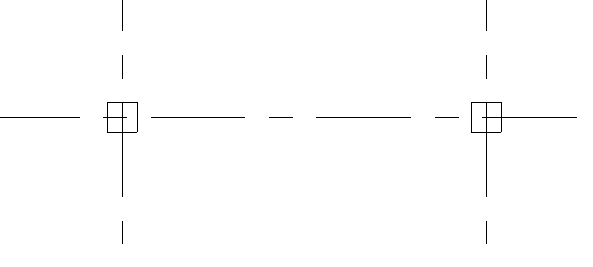
After dimensioning with the plugin:
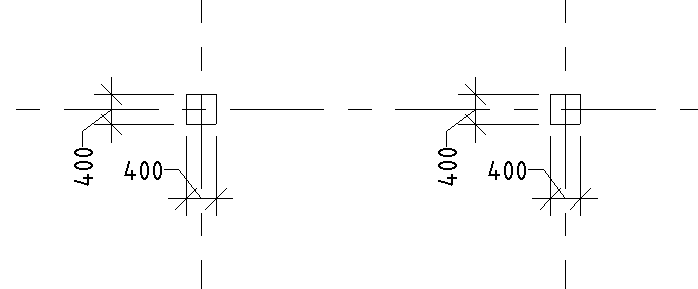
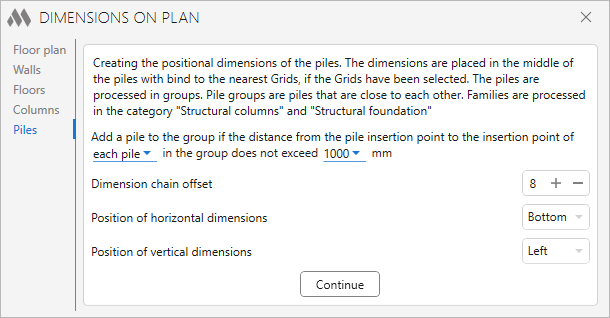
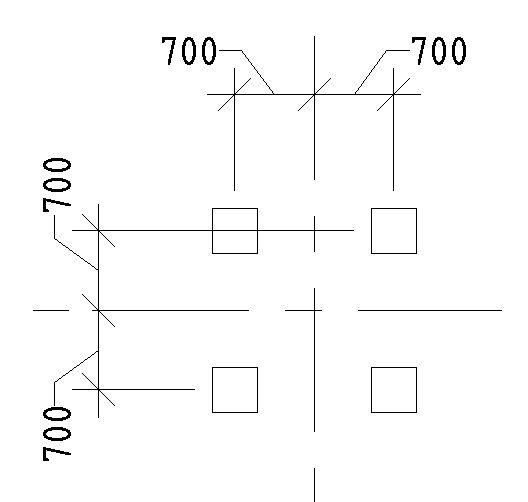
This part of the plugin makes the positioning dimensions of the piles with respect to the selected grids. This means that the dimensions will be placed from the middle of the pile to the nearest selected grids. The processing of piles is done in groups. Group of piles - piles that are located close to each other.
The settings window has the following controls:
Add a pile to the group if the distance from the pile insertion point to the insertion point of ... in the group dots not exceed ... mm – defines the logic of forming a group of piles, depending on their position relative to each other.
Dimension chain offset – defines the indent of the dimension chain from the edge of the element.
Position of horizontal dimensions – defines the placement of horizontal dimensions (Bottom, Top).
Position of vertical dimensions – defines the placement of vertical dimensions (Right, Left).
Only families of piles that fall into the categories "Structural Columns" and "Structural foundation" are processed.
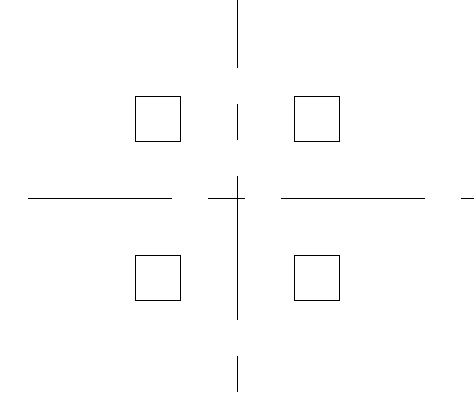
Before dimensioning with the plugin:
After dimensioning with the plugin:
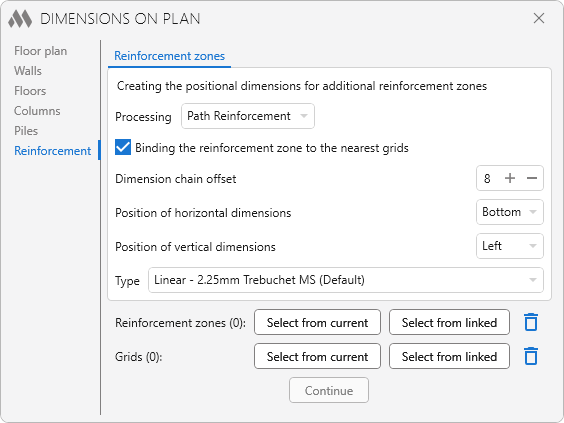
This tab is intended for dimensioning reinforcement elements.
In the Processing drop-down list, select the type of reinforcement elements to be dimensioned. The following options are available:
- Area Reinforcement
- Fabric Area
- Fabric Sheet
- Path Reinforcement.
After selecting the type, configure the dimension creation settings:
Binding the reinforcement zone to the nearest grids – when this option is enabled, additional dimensions are created from the reinforcement elements to the nearest grids. In this case, grids must be selected in the current or linked document.
Dimension chain offset – specifies the offset of the dimension chain from the object edge.
Position of horizontal dimension – defines the placement of horizontal dimensions (Bottom, Top).
Position of vertical dimension – defines the placement of vertical dimensions (Left, Right).


